NVIDIA's AI Breakthrough: ProRL Agent Decouples LLM Training at Scale
NVIDIA cuts shell command latency from 0.78s to 0.42s with new infrastructure that eliminates training bottlenecks for multi-turn AI agents.
Training an AI agent to navigate operating systems, write code, and run test suites requires competing for the same GPU resources that power its learning algorithm—a fundamental contradiction that has stalled autonomous agent development for years. NVIDIA just engineered the escape hatch.
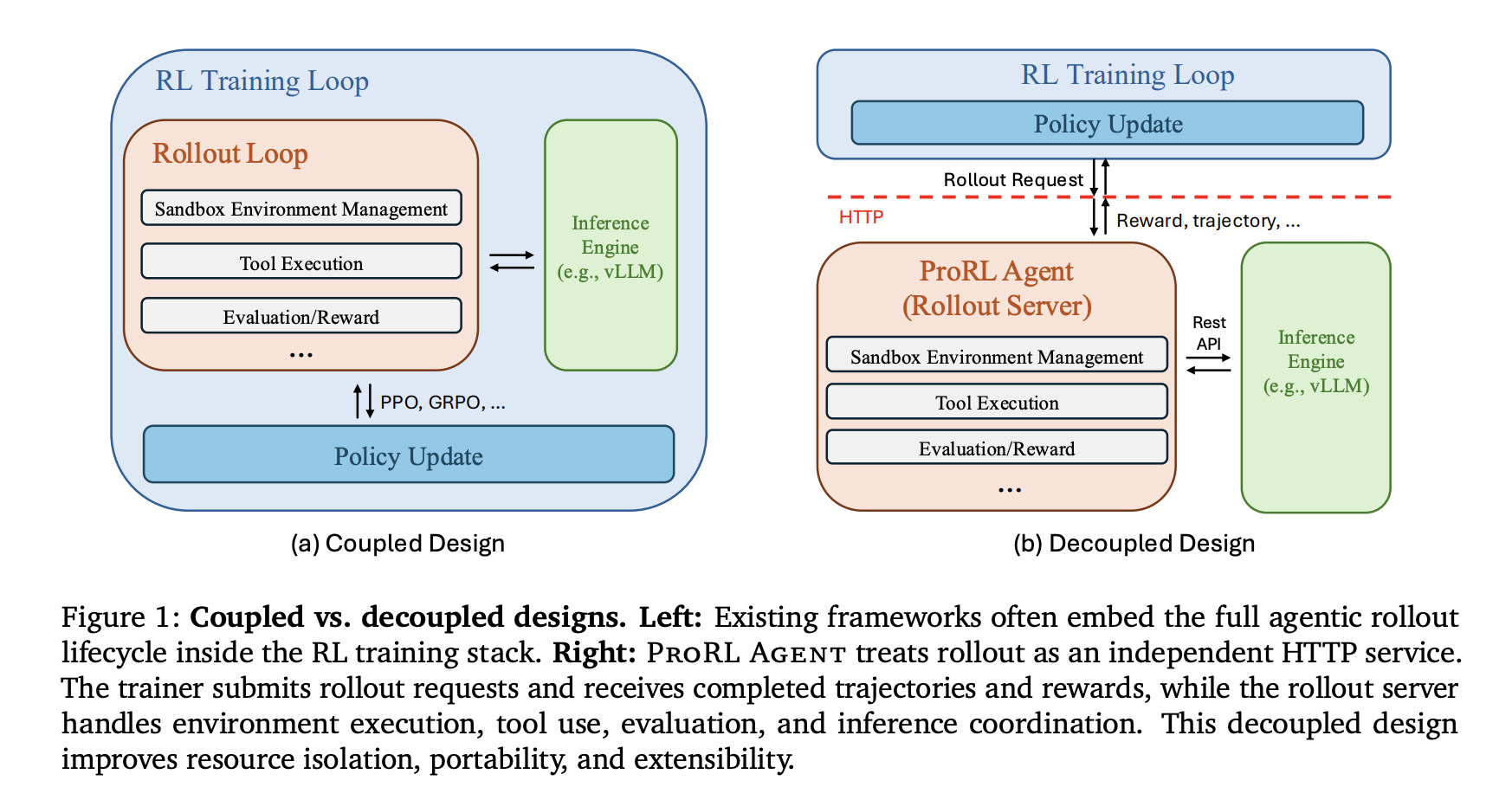
Context & Background NVIDIA researchers have introduced ProRL Agent, an infrastructure adopting a 'Rollout-as-a-Service' philosophy that decouples agent orchestration from the training loop. The core problem it solves is the resource conflict between I/O-intensive environment interactions and GPU-intensive policy updates. Previous systems including SkyRL, VeRL-Tool, and Agent Lightning embedded rollout control directly within training processes, creating conflicts that reduced hardware efficiency by up to 40% according to internal estimates.
“"By completely decoupling agent orchestration from training, ProRL Agent eliminates the most persistent bottleneck in autonomous agent development."”
Analysis & Impact ProRL Agent's three-stage asynchronous pipeline represents a fundamental shift in how enterprises and research labs can scale AI agent training. The system operates as a standalone HTTP service where the reinforcement learning trainer interacts solely through APIs, remaining agnostic to underlying infrastructure. This separation allows initialization, execution, and evaluation phases to overlap across different jobs, preventing slow evaluations—like full test suite executions—from stalling the entire rollout process.
The choice of Singularity over Docker for sandbox infrastructure is particularly significant. Singularity enables rootless execution, an essential requirement for deployment on shared HPC clusters managed by Slurm—the dominant platform in academic research and large-scale corporate development. The latency optimizations are equally impressive: replacing tmux-based multiplexing with direct pseudo-terminals reduces shell command latency from 0.78 seconds to 0.42 seconds, a 46% improvement that compounds across thousands of iterations.
Unix Domain Socket communication within containers eliminates TCP network overhead, while the direct IPython API connects to persistent kernels without network gateways. These collective optimizations target the most critical problem in agent training: tool latency, which typically dominates 70-80% of total rollout time.
The token-in/token-out communication implementation solves a subtle but devastating problem: re-tokenization drift, where token sequences generated during rollout differ from those used during training. By propagating token IDs and log-probabilities unchanged from inference backend to trainer, ProRL Agent ensures mathematical consistency—a fundamental requirement for stable reinforcement learning algorithms.
What to Watch ProRL Agent adoption could accelerate autonomous agent development by an order of magnitude, particularly in enterprise applications where legacy system integration is critical. Companies like Microsoft, Google, and OpenAI—all with massive investments in AI agents—will likely adopt similar architectures within the next 12 months.
Watch how NVIDIA positions this technology: not as an isolated product, but as foundational infrastructure for its AI ecosystem. Compatibility with vLLM and other inference backends suggests a platform strategy that could consolidate NVIDIA's leadership in large model training beyond pure hardware. The real test will come when independent labs publish benchmarks comparing ProRL Agent against open-source frameworks—if the performance advantage exceeds 30%, the de facto standard for agent training could shift permanently.
Tags