AI Race: Alibaba's Qwen3.5 Omni Shifts Multimodal Landscape
Qwen3.5-Omni-Plus achieves 215 SOTA results in audio and audio-visual tasks, surpassing Gemini 3.1 Pro. Will it redefine real-time AI interaction?
Alibaba just dropped a native multimodal model that processes text, audio, and video in one pipeline. This isn't just another tech upgrade; it's a strategic play in the global AI arms race.
The Big Picture Multimodal AI has evolved from a niche experiment to a core battleground for tech giants. For years, large language models (LLMs) relied on 'wrapper' architectures, where separate vision or audio encoders were stitched onto a text-based backbone. This approach, while functional, introduced latency and integration headaches. The industry has been craving sleeker solutions, especially as real-time applications like virtual assistants and streaming content analysis gain traction.
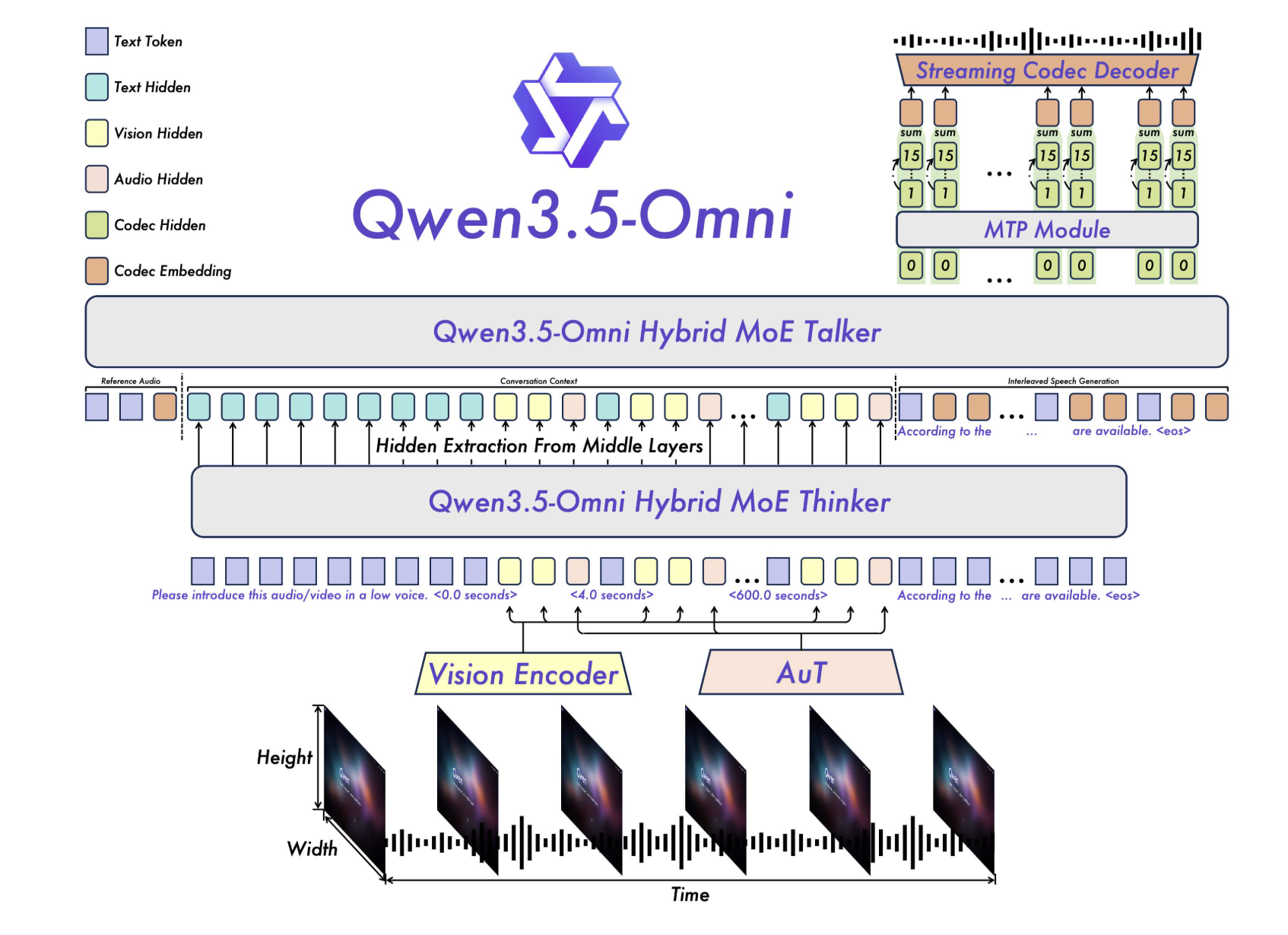
Alibaba's Qwen team has answered with Qwen3.5-Omni, a model built from the ground up to be 'omnimodal.' It's not a tech patch but a fundamental redesign. Its Thinker-Talker architecture and Hybrid-Attention Mixture of Experts (MoE) allow it to process multiple modalities simultaneously within a single computational pipeline. This positions Alibaba head-to-head with giants like Google and its Gemini 3.1 Pro model, marking a shift in how companies approach multimodality. In a market where speed and accuracy are currency, this launch could reset industry standards.
“A model that nails 215 SOTA results in audio and audio-visual tasks isn't just a tech feat; it's a declaration of war in the AI race.”
Why It Matters The significance of Qwen3.5-Omni goes beyond tech specs into economic and strategic realms. First, its ability to handle 256k-token context windows lets it ingest and reason over **over 10 hours of continuous audio or over 400 seconds of 720p audio-visual content (sampled at 1 FPS)**. That's not just a big number; it unlocks practical applications in sectors like financial markets, where processing long earnings calls or news feeds in real-time could offer competitive edges. Imagine an assistant that listens to a live broadcast and spits out instant sentiment analysis, all without lag.
Second, the model comes in three tiers: Plus for high-complexity reasoning and max accuracy, Flash for high-throughput and low-latency interaction, and Light for efficiency-focused tasks. This segmentation shows market savvy—not every app needs brute force. For investors and businesses, it means scalable options tailored to different use cases, from financial chatbots to smart property monitoring. In a world where compute efficiency drives costs, that flexibility matters.
Plus, the benchmark performance is staggering. Qwen3.5-Omni-Plus achieves State-of-the-Art (SOTA) on 215 audio and audio-visual understanding, reasoning, and interaction subtasks, spanning 3 audio-visual benchmarks, 5 general audio benchmarks, 8 ASR benchmarks, 156 language-specific Speech-to-Text Translation tasks, and 43 language-specific ASR tasks. Per technical reports, it surpasses Gemini 3.1 Pro in general audio understanding, reasoning, recognition, and translation, while matching it on audio-visual understanding. In an industry where benchmarks are credibility currency, these aren't just metrics; they're a sales pitch that could lure partners in fintech and urban development, where multimodal processing is becoming non-negotiable.


